Author: Xiaobing, Deep Tide TechFlow
Every year on the fifth day of the Lunar New Year, Xiaobing wakes up early to visit the Temple of the God of Wealth at Beigao Peak in Hangzhou.
I thought I would be jostling with aunties and uncles, but when I arrived, the scene was filled with familiar faces amidst the swirling incense smoke.
To my left was a well-known爆料KOL, to my right were community builders of pyramid schemes, and a few tech elites who usually preach "decentralization" were devoutly kowtowing with loud thuds. At that moment, no algorithmic consensus or Federal Reserve moves could compare to the three sticks of incense in their hands.
Over the past two years, mysticism has become the "mainstream" in the crypto world. If you’re still looking at K-line charts, you’re a classical韭菜 (dumb money). The real veterans are now reading八字 (fortune-telling based on birth dates).
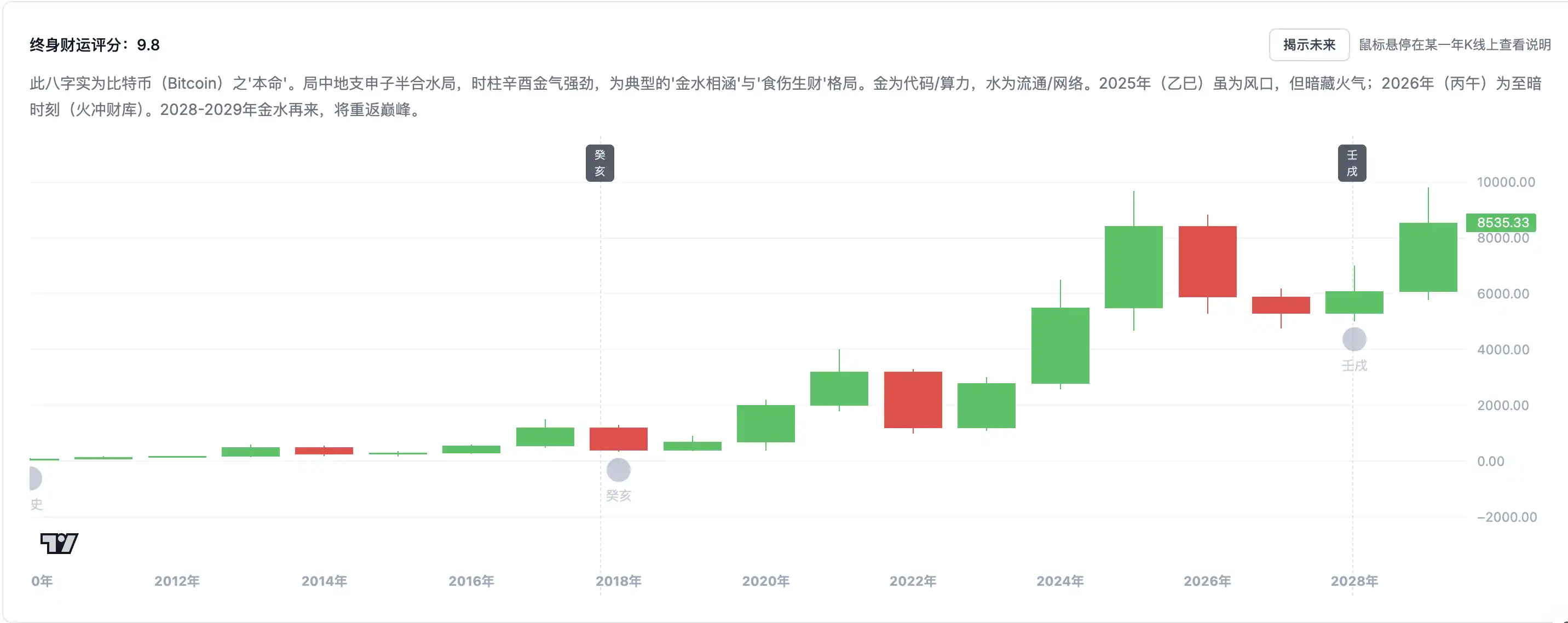
A crypto trader familiar with various indicators eventually turned to mysticism and recently calculated Bitcoin’s八字. The result was grim: Fire clashes with the wealth vault, making 2026 (the Year of the Fire Horse) Bitcoin’s darkest hour. I quickly checked my wallet—thankfully, it was already empty.
As Alen, a partner at crypto VC y2z Ventures, once bluntly stated, one of their fund’s core competencies is "reading faces." Due diligence used to focus on code audits and business models, but now it’s different. First, they check if the founder has a "wealth-draining face," then they assess whether the project’s name clashes with风水 (geomancy).
During a recent trip to Shenzhen, I noticed that traders and KOLs’ standard accessory isn’t a data terminal—it’s a "feng shui consultant" standing behind them.
Don’t laugh—this approach actually works in the crypto world. Xiaobing knows a listed company boss in Hong Kong who is a devout believer in feng shui, donating more to temples than his company spends on R&D.
And the result? Feng shui brought him noble support. He started buying Bitcoin in 2023, made hundreds of millions by hoarding it, and later rode the wave of DAT (Crypto Treasury Reserve) narratives, doubling his company’s stock price... While everyone knows this is "survivorship bias," you can’t argue with the fact that he got rich.
There are counterexamples too. A爆料KOL with a frog avatar also had a feng shui consultant who advised him not to trade recently, but he couldn’t resist playing with contracts and got liquidated neatly.
This isn’t entirely superstition.
Our traditional land-based civilization emphasizes farming—"sow one seed in spring, reap ten thousand grains in autumn"—all about certainty. But what do ocean-based civilizations face? Storms and unknown waters.
Why do people in southeastern coastal areas worship Mazu? Not because they’re ignorant, but because on the vast, unpredictable sea, besides experience and technology, you need something else.
The crypto world is essentially a modern version of the "Age of Exploration." It faces bottomless depths and sudden storms. Humans are like this: the greater the randomness and volatility, the more we seek supernatural anchors.
When K-line charts fail, and a single tweet from Elon Musk, Donald Trump, or CZ can sway the market, feng shui becomes the last psychological防线. This isn’t ignorance—it’s an instinctive应激反应 to massive wealth fluctuations.
After all, when your assets can swing 50% in a day, you need to believe in something to sleep at night. Does it matter if the God of Wealth understands blockchain?